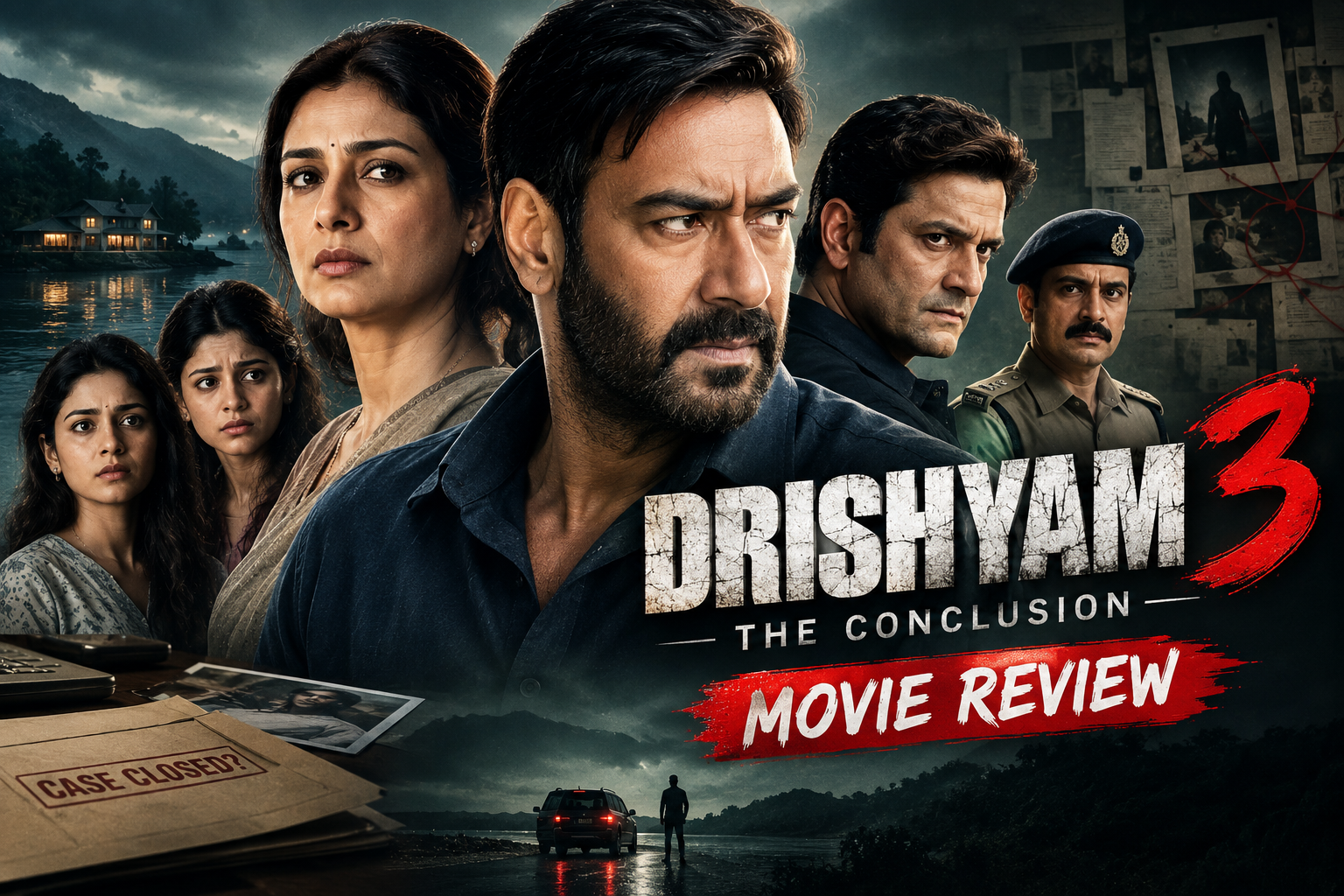
Drishyam 3: The Conclusion Movie Review: The much-awaited third instalment of the popular Drishyam franchise has finally arrived in theatres, bringing Vijay Salgaonkar back for another tense battle involving family, secrets, evidence and the law. Starring Ajay Devgn, Tabu, Shriya Saran and Jaideep Ahlawat, Drishyam: The Conclusion attempts to bring the Hindi franchise to a satisfying close.
Directed by Abhishek Pathak, the film was released in theatres on October 2, 2026. It continues the story of Vijay Salgaonkar, a man whose ability to stay several steps ahead of the police has become the defining feature of the franchise. Early reviews describe the film as a suspenseful thriller with clever twists, although opinions differ on whether its finale fully matches expectations.
Drishyam 3: The Conclusion Story
The story continues with Vijay Salgaonkar and his family attempting to maintain their lives after the disturbing events of the previous films. Although time has passed, the consequences of the past have not disappeared.
Vijay has always depended on careful planning, patience and his understanding of how people think. His greatest strength is his ability to anticipate the next move of those trying to expose him. However, the third chapter places his family under renewed pressure as the investigation and the search for truth continue.
Meera Deshmukh, played by Tabu, remains emotionally connected to the tragedy involving her son. Her determination to find answers adds another layer to the conflict. The arrival of new investigative forces further complicates matters, creating fresh challenges for Vijay.
The central question remains the same: can Vijay protect his family while keeping the truth hidden?
The film builds its narrative around suspicion, deception and the possibility that even the most carefully constructed plan can eventually develop cracks. Rather than relying entirely on action, it uses conversations, investigations and psychological tension to move the story forward.
Ajay Devgn as Vijay Salgaonkar
Ajay Devgn once again takes centre stage as Vijay Salgaonkar, the ordinary family man whose extraordinary planning has made him one of Hindi cinema’s memorable thriller characters.
His performance depends heavily on restraint. Vijay is not someone who reveals everything through dramatic speeches or exaggerated expressions. Instead, Devgn uses controlled expressions, silence and carefully delivered dialogue to communicate the character’s calculations.
This approach suits the franchise because Vijay’s intelligence has always been more important than physical strength. He observes people, studies situations and attempts to remain calm even when the stakes are extremely high.
In Drishyam: The Conclusion, Devgn continues that familiar approach while facing the challenge of giving the character a final chapter. His performance provides continuity with the earlier films and keeps the emotional stakes connected to the Salgaonkar family.
Tabu’s Powerful Return
Tabu returns as Meera Deshmukh, a character driven by grief, determination and the desire for answers. Her relationship with Vijay remains one of the franchise’s most important sources of tension.
The conflict between these characters works because neither side is simply a conventional hero or villain. Both carry emotional burdens, and their opposing objectives create a complicated psychological battle.
Tabu brings intensity to the role, especially in scenes where grief becomes determination. Her character’s continued pursuit of the truth ensures that Vijay cannot completely escape the consequences of his earlier decisions.
The film’s central conflict benefits from the contrast between Vijay’s calm calculations and Meera’s emotional urgency.
Jaideep Ahlawat and the Supporting Cast
Jaideep Ahlawat joins the story as Rajveer Singh Tomar, a crime branch officer whose involvement adds another challenge for Vijay. His presence changes the dynamics of the investigation and introduces a different personality into the franchise’s familiar cat-and-mouse structure.
Shriya Saran and Ishita Dutta also return as members of the Salgaonkar family. Their roles are important because the consequences of Vijay’s choices extend beyond his individual struggle.
The supporting cast helps establish the emotional cost of keeping secrets for years. However, the film’s effectiveness depends on how much space the screenplay gives these characters to express their fears and personal conflicts.
Direction, Screenplay and Suspense
Director Abhishek Pathak faces a difficult task with Drishyam 3: The Conclusion. The earlier films established a reputation for unexpected turns, carefully planted clues and situations that encouraged viewers to question their assumptions.
Repeating that formula without making the story predictable is a significant challenge.
The film maintains the franchise’s focus on investigation, deception and the relationship between evidence and perception. Its strongest moments come when a seemingly ordinary detail takes on new meaning or when a character’s decision changes the direction of the investigation.
However, the screenplay is not equally effective throughout. India Today’s review describes the film as a good thriller whose finale falls short of the grand farewell some viewers may expect. Rotten Tomatoes’ early critic summaries also reflect mixed opinions, with praise for the writing and performances alongside criticism of certain narrative choices.
The pacing and emotional weight of the conclusion will therefore depend partly on how strongly viewers connect with the previous instalments.
Cinematography, Music and Atmosphere
The visual style of Drishyam: The Conclusion supports its serious crime-thriller atmosphere. Rather than depending entirely on large action sequences, the film concentrates on conversations, investigations and tense encounters.
The background score helps build anticipation during moments when characters are attempting to understand what has happened. In a franchise built around secrets and revelations, music can increase tension, although excessive scoring can sometimes reduce the natural impact of a scene.
The film’s atmosphere is most effective when the visuals remain understated and allow the performances and dialogue to carry the suspense.
Is Drishyam 3: The Conclusion Worth Watching?
For viewers who have followed Vijay Salgaonkar’s story from the beginning, this final chapter offers an opportunity to revisit the characters and see how their conflict develops.
The performances, particularly those of Ajay Devgn and Tabu, provide continuity with the earlier films. Jaideep Ahlawat adds another dimension to the investigation, while the screenplay continues exploring the consequences of secrets and carefully constructed lies.
However, viewers should not expect every twist to deliver the same surprise as the original film. A third instalment inevitably faces the challenge of balancing familiarity with fresh ideas.
Those who enjoy slow-burning crime dramas, psychological battles and investigative thrillers are likely to find elements worth appreciating. Viewers expecting nonstop action may find the emphasis on dialogue and investigation less exciting.
Final Verdict
Drishyam 3: The Conclusion is a suspense-driven continuation of Vijay Salgaonkar’s story, supported by committed performances and the franchise’s familiar mind games. Ajay Devgn returns comfortably to the role, Tabu maintains the emotional intensity, and Jaideep Ahlawat adds a new presence to the investigation.
The film’s main challenge is delivering a conclusion that feels as memorable as the twists that established the franchise. While early reviews praise aspects of the thriller, some critics believe the finale does not completely meet the expectations attached to the series.
For fans of the earlier films, Drishyam: The Conclusion is a chapter worth exploring, particularly for its performances and the continuing conflict between Vijay and those seeking the truth.
Drishyam 3: The Conclusion Rating: 3/5