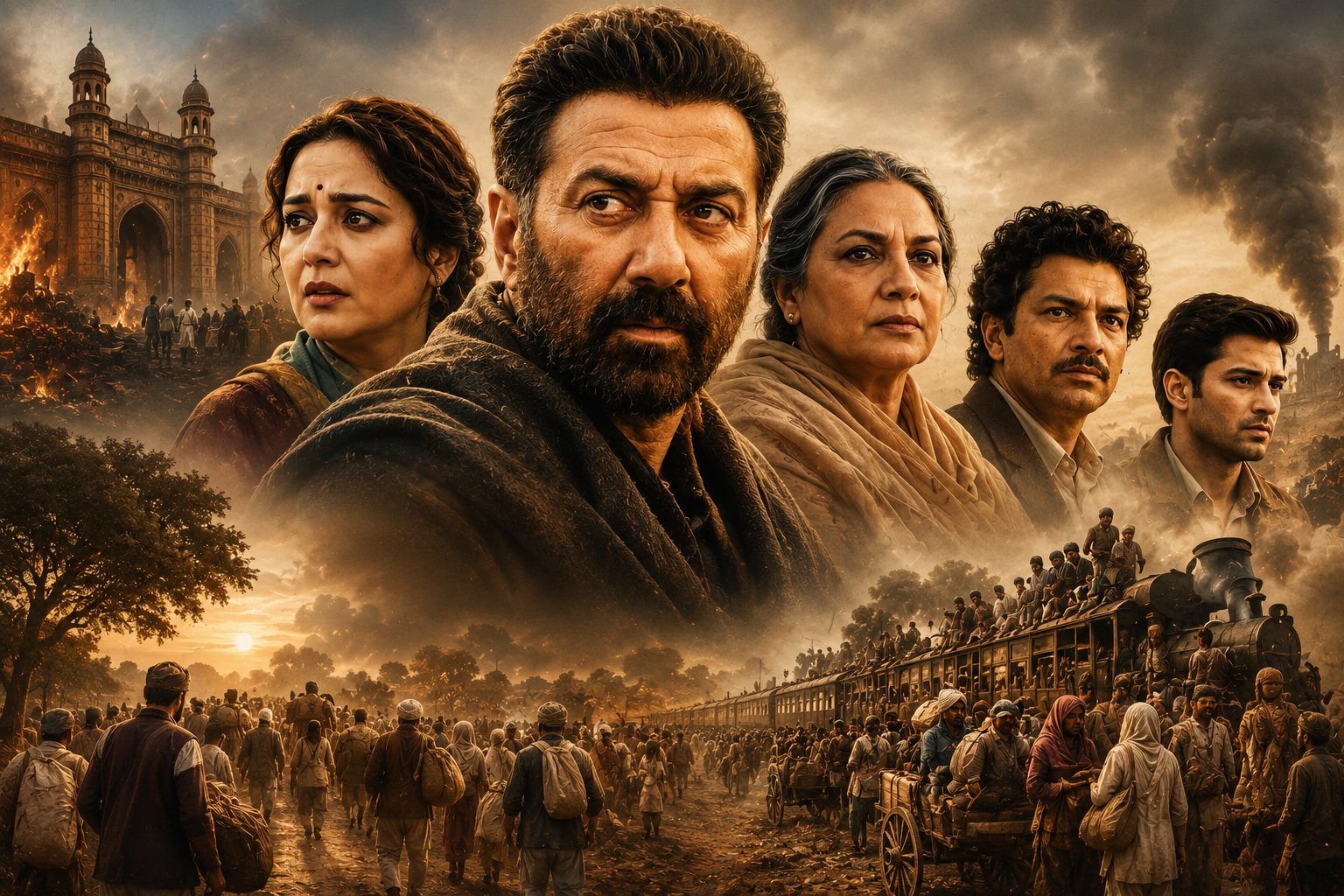
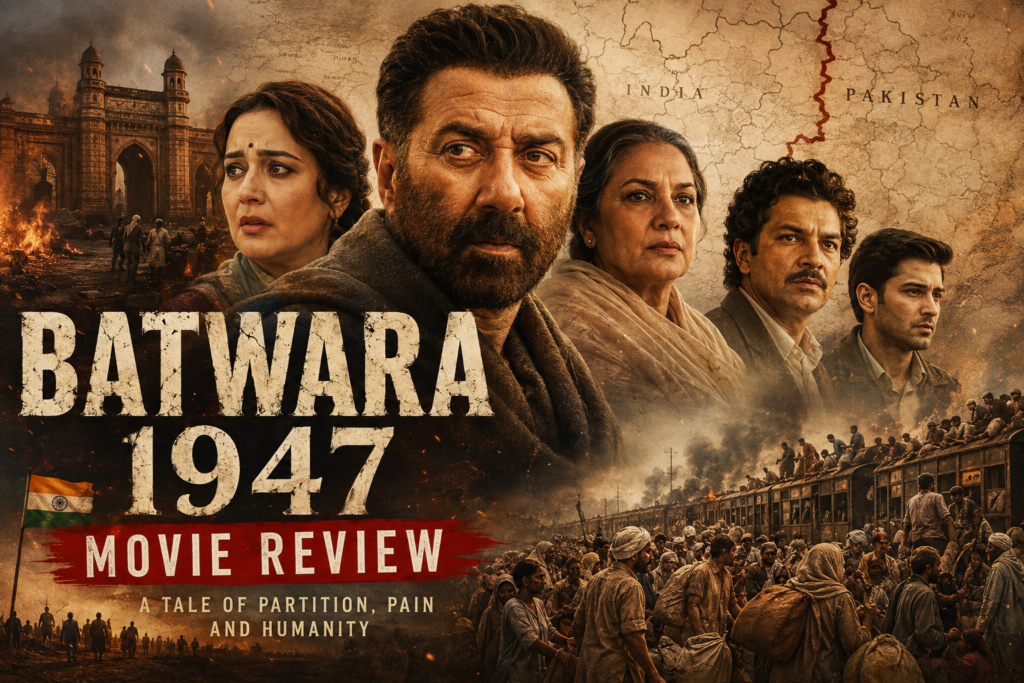
Batwara 1947 arrives with the difficult task of telling a story that has already been explored many times in Indian cinema: the Partition of 1947. Directed by Rajkumar Santoshi and produced by Aamir Khan Productions, the film stars Sunny Deol, Preity Zinta, Shabana Azmi, Ali Fazal and Karan Deol. It released in theatres on August 14, 2026, just ahead of Independence Day.
Rather than presenting Partition only as a political event, Batwara 1947 focuses strongly on the ordinary people caught in the middle of it. The film explores displacement, family, fear, loss and the struggle to protect humanity when society itself is breaking apart.
Story and Setting
The story is set against the chaotic backdrop of India’s Partition. The trailer introduces a family whose life changes dramatically after the country is divided. What begins with the happiness of independence quickly turns into uncertainty as families are forced to leave their homes and cross borders.
Sunny Deol plays Sikander Mirza, a character who becomes deeply involved in protecting his family during the dangerous journey. His character carries the emotional and physical weight of the story, combining determination with the pain of seeing people lose their homes and loved ones.
The film also explores what happens after migration. One of its interesting ideas is that people from different communities are suddenly forced to live with the consequences of a division they did not necessarily choose. This gives the story an opportunity to examine whether humanity can survive when religious and political identities become barriers.
Sunny Deol’s Performance
Sunny Deol is clearly the biggest attraction of Batwara 1947. His reunion with director Rajkumar Santoshi comes nearly three decades after some of their most memorable collaborations, making the film especially interesting for Bollywood fans.
Deol brings his familiar intensity to Sikander Mirza. There are moments where his physical presence and powerful dialogue delivery dominate the screen, but the more effective scenes are those in which the character has to deal with fear, family and helplessness.
The early reactions to the film have particularly highlighted Deol’s performance as one of its strengths.
Preity Zinta and Shabana Azmi
Preity Zinta returns to the big screen in an important role, appearing opposite Sunny Deol. Her character adds an emotional dimension to the family story, particularly as the couple faces the uncertainty created by Partition.
Shabana Azmi is another major strength. Her presence brings experience and emotional depth to a story dealing with displacement and loss. Reports surrounding the film’s trailer launch also highlighted how emotionally difficult some of the material was for Azmi.
Ali Fazal, Karan Deol and the supporting cast add further layers to the ensemble.
Direction and Technical Aspects
Rajkumar Santoshi approaches Partition as both a historical tragedy and a human story. The film’s period setting, production design and cinematography attempt to recreate the atmosphere of a country experiencing enormous social upheaval.
The technical team is also impressive. Santosh Sivan serves as cinematographer, while A.R. Rahman handles the music and Javed Akhtar contributes lyrics. Resul Pookutty is credited with sound, giving the project a strong technical lineup.
The music is particularly important because a film about Partition needs emotional moments to feel genuine rather than manufactured. The soundtrack helps strengthen the atmosphere of nostalgia, separation and hope.
What Works
The biggest strength of Batwara 1947 is its emotional subject. Partition remains one of the most painful chapters in South Asian history, and the film reminds viewers that behind political decisions were millions of ordinary people whose lives were permanently changed.
The performances, particularly those of Sunny Deol and Shabana Azmi, give the story weight. The film also attempts to move beyond simple patriotism by emphasizing compassion and humanity.
Its Independence Day release adds another layer to the viewing experience. The contrast between celebrating freedom and remembering the enormous human cost surrounding independence makes the film particularly relevant during this period.
What Could Have Been Better
The subject is powerful, but that also creates a challenge. Partition dramas need to balance emotional storytelling with historical sensitivity. At times, Batwara 1947 can feel like a conventional Bollywood drama rather than a completely unpredictable historical narrative.
Some viewers may also find the intense action and dramatic presentation familiar, especially because Sunny Deol has become closely associated with patriotic and India-Pakistan-themed cinema.
Still, the film’s emotional core helps it rise above these familiar elements.
Final Verdict
Batwara 1947 is an emotional Partition drama built around family, survival and humanity. Sunny Deol delivers a strong central performance, while Preity Zinta and Shabana Azmi add emotional depth to the story.
The film may not completely reinvent the Partition genre, but it succeeds in reminding audiences that history is not only about borders and political decisions. It is also about families, homes, memories and people forced to leave everything behind.
For viewers interested in historical dramas, powerful performances and stories about Partition, Batwara 1947 is worth considering in theatres.
Rating: 3.5/5
Batwara 1947 is ultimately a film about what happens when a country is divided, but its people continue searching for one thing that cannot easily be divided: humanity.