Daayra Movie Review: Some films are made simply to entertain, while others are designed to leave the audience with questions long after the credits roll. Meghna Gulzar’s Daayra belongs firmly to the second category. Starring Kareena Kapoor Khan and Prithviraj Sukumaran, this crime drama enters uncomfortable territory, examining crime, policing, justice and the difficult boundary between what is legal and what people believe is right.
Released in theatres on September 18, 2026, Daayra brings together two major performers for the first time. The film has a serious tone from the beginning and chooses a procedural approach rather than turning its subject into a conventional action thriller.
Daayra Movie Story
The story revolves around a disturbing rape and murder case that creates enormous public anger. At the same time, a police encounter involving the accused becomes the centre of another controversy.
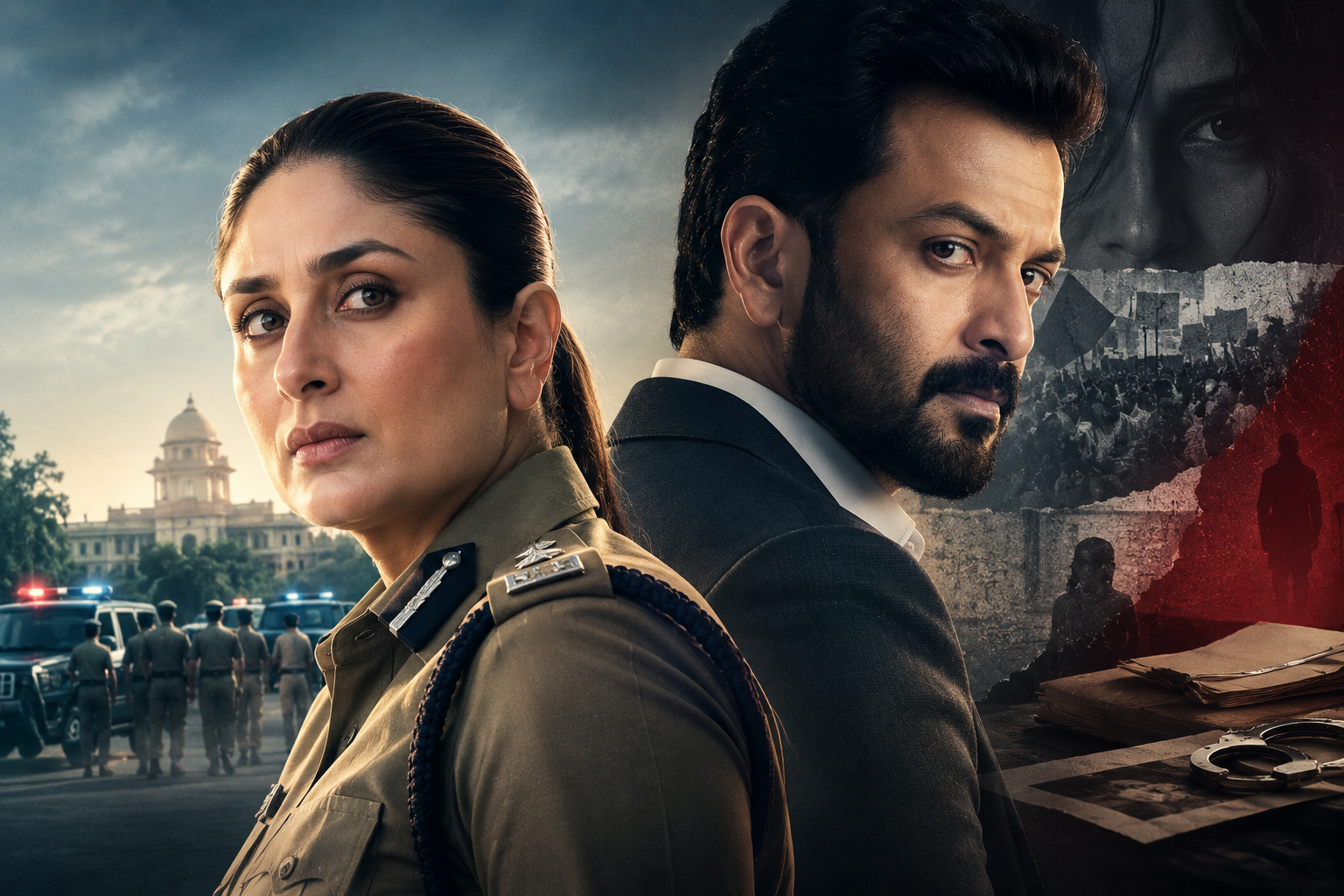
On one side is DCP Raman Kumar, played by Prithviraj Sukumaran, a police officer whose actions make him a public figure in the aftermath of the case. On the other side is DCP Ajooni Kohli, played by Kareena Kapoor Khan, who becomes involved in investigating the circumstances surrounding the encounter.
The film’s central conflict is therefore not simply about catching criminals. It is about what happens when the desire for immediate justice comes into conflict with the procedures of law.
This gives Daayra a much more complicated foundation than a standard police thriller.
The film is inspired by publicly known events, while presenting its story as fiction. Its premise draws attention to questions surrounding police encounters, public reactions and the difference between punishment and due process.
Kareena Kapoor Khan as DCP Ajooni Kohli
Kareena Kapoor Khan takes on a serious police role in Daayra, playing DCP Ajooni Kohli.
The character is not presented as a typical Bollywood cop who solves everything through dramatic confrontations. Instead, Ajooni’s investigation requires patience, observation and an understanding of how different versions of the same incident can exist.
Kareena keeps her performance relatively controlled, which suits the film’s procedural atmosphere. Her character has to deal with professional pressure while investigating a case that has already created strong public emotions.
Some critics have questioned how fully the screenplay develops Ajooni’s character, while others have appreciated Kareena’s restrained performance. That difference in critical response is worth noting because the role is clearly intended to be more about investigation and moral conflict than conventional heroism.
Prithviraj Sukumaran’s Performance
Prithviraj Sukumaran plays DCP Raman Kumar, and his performance is one of the most consistently discussed aspects of the film.
Raman is a complicated figure because the public perception of him is very different from the questions raised by the investigation. Prithviraj does not play him as a straightforward hero or villain. Instead, he gives the character an outward confidence while allowing moments of uncertainty and tension to emerge underneath.
This approach works particularly well because the film wants the audience to think about Raman’s actions rather than simply accept one interpretation of them.
Several reviews have singled out Prithviraj’s performance as a major strength, describing it as controlled and effective.
Meghna Gulzar’s Direction
Meghna Gulzar has previously explored complicated subjects where there is rarely an easy answer, and Daayra continues that approach.
Her direction focuses more on atmosphere, investigation and conversations than on spectacle. The film spends time establishing the circumstances surrounding the case and showing how different people respond to it.
This slow-burn approach will work better for viewers who enjoy serious crime dramas rather than fast-paced thrillers.
The film’s opening sections deliberately take their time. One criticism raised by some reviewers is that the pacing can feel slow, particularly before the investigation gathers momentum. Other critics have found the restrained approach appropriate for the subject matter.
Screenplay and Moral Conflict
The strongest idea in Daayra is its moral conflict.
The film asks a simple but difficult question: Can an illegal act ever be considered justice if the public believes the result is deserved?
Rather than providing a comfortable answer, the screenplay places its characters within different sides of the argument.
The public wants closure. The police have their own version of events. Investigators want evidence. And the legal system demands procedure.
This creates an interesting tension because everyone appears to have a reason for what they believe.
The movie also explores how media attention and public emotion can influence perceptions of guilt and justice. These themes make Daayra more than a conventional investigation story.
First Half and Second Half
The first half focuses heavily on establishing the crime, the police officers and the circumstances surrounding the encounter.
This section benefits from the mystery surrounding what actually happened.
The second half becomes more concerned with the investigation and its implications. This is also where opinions about the film become more divided.
Some reviewers have felt that the movie loses momentum in the latter portion and that the climax does not completely deliver on the strength of the setup. Others have found the moral ambiguity of the conclusion consistent with the film’s central theme.
The result is a film that may leave viewers discussing its questions rather than simply remembering its plot.
Cinematography and Background Score
Visually, Daayra maintains a serious and grounded look. The cinematography avoids unnecessary glamour and supports the film’s investigative mood.
The background score is similarly restrained. Instead of constantly pushing the audience toward an emotional reaction, it works mainly to increase tension during important sequences.
The overall presentation feels closer to a serious procedural drama than a traditional commercial Bollywood thriller.
What Works in Daayra?
The film’s biggest strength is its subject.
Daayra doesn’t treat its central case simply as a mystery that needs to be solved. It uses the investigation to explore questions about law, morality and public perception.
The performances are another positive, particularly Prithviraj Sukumaran’s portrayal of Raman Kumar. Kareena Kapoor Khan also brings seriousness to a role that requires restraint rather than exaggerated heroics.
The film’s willingness to leave certain questions open can also be appreciated. It trusts the audience to think about the situation rather than explaining every moral issue.
What Could Have Been Better?
The pacing is the most noticeable issue.
At around 143 minutes, the film has enough time to explore its subject, but some portions could have been tighter. The second half, in particular, has been described by critics as less effective than the setup.
The balance between its two central characters can also feel uneven. While Prithviraj’s Raman gets considerable dramatic weight, some reviewers have felt that Kareena’s Ajooni is not developed as strongly as the premise suggests.
Still, these issues don’t erase the ambition behind the film.
Final Verdict
Daayra is a serious and morally complicated crime drama that chooses questions over easy answers. Meghna Gulzar uses the police investigation to explore the uncomfortable space between law, justice, revenge and public opinion.
Kareena Kapoor Khan and Prithviraj Sukumaran bring contrasting energies to the story, with Prithviraj’s performance receiving particularly strong attention from several critics.
The film may feel slow in places, and its second half has divided critical opinion, but its central subject gives it plenty to discuss after the movie ends.
Is Daayra Worth Watching?
If you enjoy serious Bollywood crime thrillers, police procedurals and movies based around moral dilemmas, Daayra offers plenty to think about. It is not a typical action-packed cop film. Instead, it is a character-driven investigation that asks viewers to consider where justice ends and vigilantism begins.
Daayra is ultimately a film about the grey area between what the law says and what society wants—and that uncomfortable space is what makes the movie worth discussing.